
Intergroup Contact Research Network News - October 2025
Contact Colloquium series, Recent Advances and more ...

Welcome to the October 2025 Edition of the ICRN Newsletter!
We are delighted to share the latest updates from the International Contact Research Network. In this issue, you’ll find news from our Contact Colloquium series, which returns this month with a new line-up of inspiring speakers and a segment designed to support our early postgraduate researcher community.
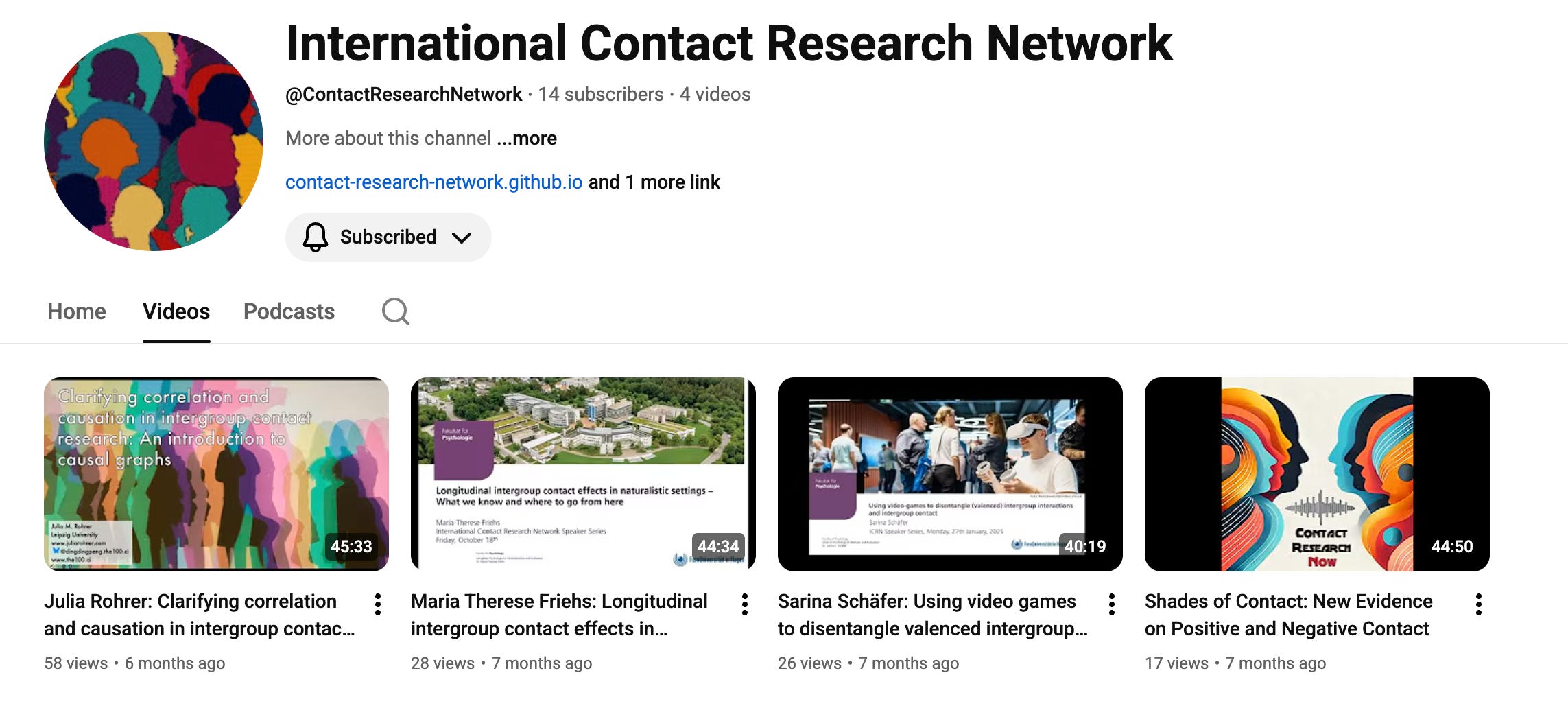
We’re also pleased to announce that you can now find past talks and podcasts on our official YouTube channel, where we invite you to watch, share, and subscribe.
In addition, we highlight several recent publications by ICRN members and share a concise summary of recent advances in intergroup contact research.
As our global community continues to grow, we’re glad to keep you connected through these termly newsletters. If you have suggestions or items to share in future editions, we’d love to hear from you.
Feel free to share this newsletter with colleagues who may be interested in joining our network.
Happy reading!
Contact Colloquium: New Season Launch
We begin by warmly thanking Michèle Denise Birtel for leading the Contact Colloquium last year. This season, Patrick Kotzur and Beatriz Casquinho will coordinate the series. ICRN’s monthly colloquium returns with a wonderful line-up of speakers and a new segment designed to address the wishes and needs of our early postgraduate researcher community.
The full list of speakers and the schedule will be shared soon. In the meantime, please save the date for our opening talk.
Friday, 31 October 2025, 15.00–16.00 (UK time)
The rhythm is gonna get you. What people do during contact matters.
Prof. Jake Harwood, University of Arizona

This talk will discuss the importance of considering “what happens” during intergroup contact. It argues that specific activities that parties engage in during contact have implications for the mechanisms likely to mediate contact’s effects. Experimental studies of indirect contact’s effects will be discussed, including studies focusing on musical activity as a particularly potent platform for intergroup contact. The talk concludes with thoughts on the diversity and complexity of “positive intergroup contact.”
As always, the Colloquium is open to everyone and held on Teams. ICRN members receive calendar invitations automatically, while non-members can register for individual sessions through the link above. Slides, recordings, and updates on future sessions will be available on the Contact Colloquium page.
💡 Brainstorm Ideas for the Colloquium Series
We would love to hear your ideas for future colloquium sessions. Please share your ideas for future sessions by completing our short form. Your input will help shape the next phase of the Colloquium and ensure it reflects the interests of our community.
Contact Meet-Up around EASP 2026
We are planning to run our yearly contact meeting alongside the EASP 2026 General Meeting, possibly as a post-conference in Karlsruhe, which is close to the General Meeting location. Further details about timing and format will follow. We hope to see many of you there. Please note that the EASP submission deadline got extended to Nov 7, 2025, so that you still have a little bit of time to get your abstract in.
🎥 Watch and Subscribe to Our YouTube Channel
You can now watch past Contact Colloquium talks and Contact Research Now podcast episodes on our official YouTube channel, International Contact Research Network. The channel features recordings from previous sessions by Julia Rohrer, Maria Therese Friehs, Sarina Schäfer, and more. Subscribe to stay up to date with our latest talks and research discussions.
Recent Contact Publications by ICRN Members
ICRN members have continued to publish a wide range of exciting contact research. Below we highlight a few papers that caught our attention, to see more click here.
Cameron, L., Drury, L., Torwu, E. Y., & Cane, J. (2025). Meaningful intergenerational contact to build social connections, enhance felt understanding and build confidence in future community social action. Journal of Community & Applied Social Psychology, 35(5), e70157.
Dierckx, K., Van Hiel, A., Maene, C., Stevens, P. J., & Van Assche, J. (in press). Can Intergroup Contact ‘Backfire’? Direct and Indirect Secondary Transfer Effects of Majority Group Member Friendships Among Belgian Muslim Adolescents. Journal of Community and Applied Social Psychology.
Rosa Policardo, G., Prati, F., Burak, C., Van Assche, J., & Rubini, M. (in press). Fostering Solidarity Among Ethnic Minority Groups: Addressing the Role of Inter-minority Contact in Cross-cultural Contexts. International Review of Social Psychology.
If you’d like to highlight one of your recent publications in a future issue, please email us with the full citation (APA style preferred) and a link to the article or preprint. We aim to keep this section concise while showcasing a diverse range of member contributions.
Recent Advances in Contact Research
Summaries by Emine Bilgen.
Friendship Influence and Normative Pressure in Adolescent Attitudes
Who shapes adolescents’ attitudes and behaviours? This study distinguishes between two key forms of peer influence in schools: friendship influence and normative pressure. Friendship influence arises within close, voluntary relationships that allow open communication and mutual persuasion. Normative pressure, in contrast, comes from peers who share group memberships, such as gender or ethnicity, and exert influence through shared norms and expectations rather than personal closeness.
Drawing on data from 2,838 German adolescents across 29 school classes, the researchers used longitudinal social network modelling to track how academic drive, prejudice, and religiosity spread among students. They found that adolescents influence one another both through friendships and through shared group memberships. Same-gender peers exerted particularly strong influence, while the effect of ethnicity varied depending on the outcome studied.
The findings highlight that peer influence in schools extends far beyond close friendships. Students tend to mirror not only their friends but also the broader social norms of their peer groups. When certain attitudes or behaviours become common, normative pressure strengthens; when they are rare, students sometimes push back, possibly out of a desire to be unique.
This study advances our understanding of how attitudes, prejudice, and even religiosity evolve through overlapping social networks. It also has practical implications for school-based interventions: efforts to change behaviour or reduce prejudice should consider both friendship ties and group norms, as overlooking either can limit impact or even risk reinforcing divisions.
Zingora, T., & Flache, A. (2025). Effects of Friendship Influence and Normative Pressure on Adolescent Attitudes and Behaviors. Personality and Social Psychology Bulletin, Advance online publication. https://doi.org/10.1177/01461672251366388
Do you have feedback on the newsletter, or anything you want to share? Email us: emine.bilgen@btu.edu.tr
Want to join the Network? Check our webpage